


Test Data Provisioning

The ticket is approved, but the test still waits for valid data

Sixpack replaces slow, manual, and script-heavy test data provisioning with self-service requests for business-valid datasets, so teams can start testing without waiting for another team to assemble or validate the data.

Self-service requests instead of tickets
Buffered ready states for common needs
Owned generator logic by domain teams
Concrete failure mode

A simple data request turns into a cross-team queue

The tester knows the scenario, but not every dependency behind it. The request waits for people who understand billing, orders, identity, and downstream lifecycle rules.

09:12

Provisioning ticket opened

Waiting

Another team needs to provision data manually

Later

Testing finally starts

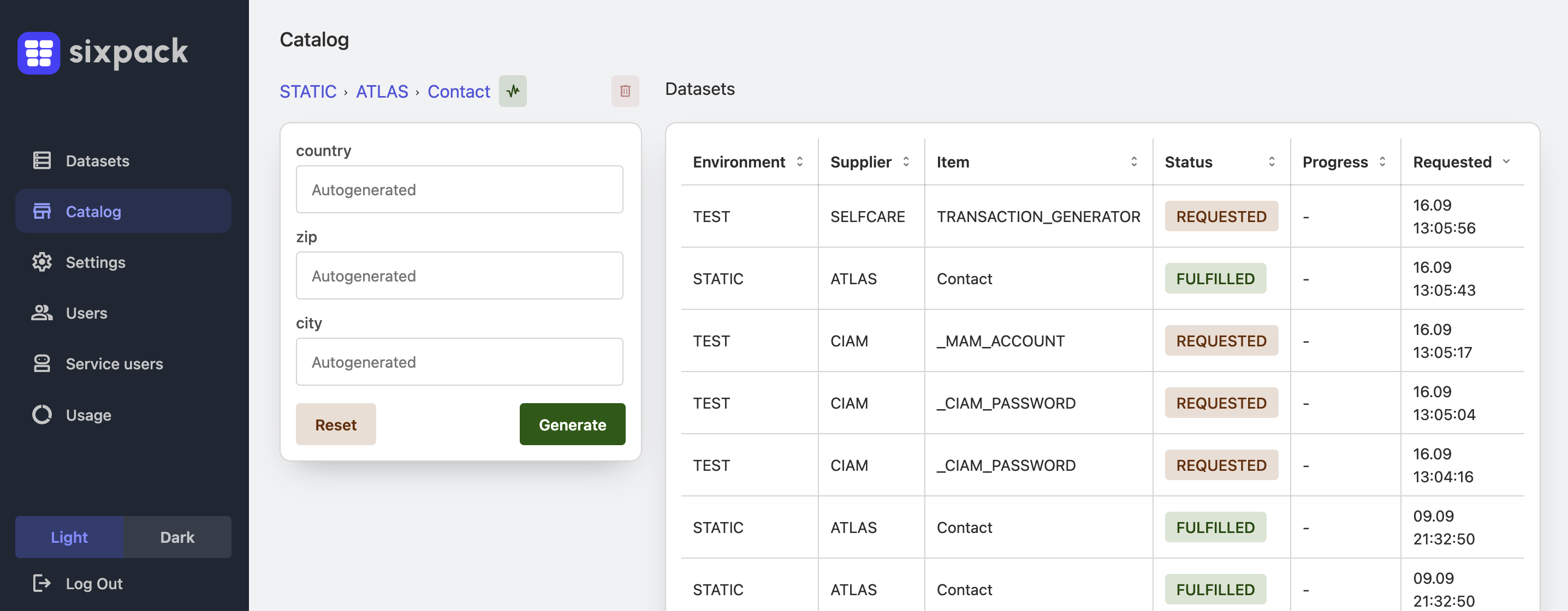
Sixpack catalog interface
Request test data

Request State

Ask for the data
the test needs

Provision valid data

Provision Data

Receive valid state
without manual handoffs

Start testing

Start Testing

Run with prepared
business-valid data

Definition

What test data provisioning means

Test data provisioning is the delivery of the right dataset to the right environment before a manual test, automated suite, or pipeline starts. In distributed systems, the hard part is not only creating data, but proving that the resulting state is valid across the systems involved.

Sixpack turns that work into a requestable platform capability built on buffered datasets, self-service access, generator orchestration, leasing, and lifecycle control.

Symptoms it fixes

  • Testers wait for ticket-driven data preparation before a scenario can start
  • Setup scripts depend on hidden service order, credentials, IDs, or manual fixes
  • Valid data can only be confirmed by another team that understands downstream rules
  • Manual provisioning works once, then becomes impossible to repeat reliably
  • Automation falls back to stale hard-coded datasets because fresh data is too slow to get

Where Test Data Provisioning Slows Down

The test is ready, but the valid starting state is still owned by a manual workflow

Failure mode

The request is clear, but the data is not ready

A tester needs a customer, policy, account, or order in a specific lifecycle state. The test cannot start until someone else assembles the state, checks downstream dependencies, and confirms it is safe to use.

Failure mode

Scripts hide the architecture instead of removing the wait

One-off scripts may create records quickly, but they still encode fragile service order, environment assumptions, and validation steps that only a few people understand.

Failure mode

People become the validation layer

When the platform cannot prove whether data is valid across systems, teams compensate with chat messages, tickets, and manual confirmation from the service owners.

How Sixpack Fixes It

Only the capabilities that reduce provisioning wait time and operational friction

Sixpack keeps data creation knowledge with the teams that own the systems, but removes the need for every requester to rediscover that knowledge. The consumer requests the business state; Sixpack handles delivery through catalogue access, buffering, orchestration, and lifecycle control.

Replacement for manual provisioning

The goal is not to make people fill in better request forms. The goal is to make valid test data available through a reusable platform contract so manual setup, tickets, and script handoffs become exceptions rather than the normal path.

Self-service data requests

Sixpack exposes dataset types through a catalogue and REST API, so testers and pipelines request the business state they need without opening a provisioning ticket.

Buffered ready states

Commonly requested states are pre-generated and stocked ahead of demand, reducing the wait between deciding what to test and actually starting the scenario.

Domain-owned generators

The teams that understand each system maintain the generator logic, while consumers use one consistent request model instead of learning every service dependency.

Leasing and lifecycle control

Provisioned datasets can be reserved, expired, refreshed, or cleaned up by policy, which keeps shared environments usable after the request has been fulfilled.

What The Requester Actually Does

A practical flow from data need to executable scenario

Provisioning flow

1. Request a business state

A tester or pipeline chooses the required dataset type, environment, and scenario without describing every table, API call, or downstream dependency.

Provisioning flow

2. Allocate ready or generated data

Sixpack returns a stocked dataset immediately when available, or routes the request through the relevant generator chain when the state has to be prepared.

Provisioning flow

3. Test without a manual handoff

The consumer receives usable references and metadata for a valid dataset, then starts execution without waiting for another team to validate the setup.

Provisioning As An Operating Model

How valid data becomes available without putting architecture knowledge on every requester

Strategy

Catalogue-driven discovery

Available dataset types become visible through one request surface instead of scattered scripts, team-specific instructions, or tribal knowledge.

Strategy

Cross-system orchestration

Provisioning can coordinate generator capabilities across services so the delivered state is coherent, not just locally inserted into one system.

Strategy

Operational buffering

Preparing high-demand states before they are requested keeps testing moving even when some systems needed for generation are slow or temporarily unstable.

Strategy

Request tracking

When a dataset cannot be delivered immediately, the request remains visible through the platform instead of disappearing into a chat thread or ticket queue.

Valid data should be requested by business state, not rebuilt from system knowledge

Sixpack lets consumers ask for the dataset outcome they need while generator ownership, cross-system orchestration, buffering, leasing, and lifecycle control handle the operational work behind that request.

Less waiting

Teams spend less time blocked on data preparation and more time testing the behavior they planned to validate.

Fewer handoffs

Consumers request the outcome they need while domain teams preserve correctness through reusable generator capabilities.

More repeatability

Provisioning becomes a platform contract that can be reused across testers, suites, pipelines, and environments.

What Changes When Provisioning Is Self-Service

Practical outcomes teams see when data delivery stops depending on manual confirmation

Hidden dependencies

Valid data does not require the requester to understand the full architecture

The request names the business state. Sixpack handles the generator chain, dependency order, and delivery metadata behind the platform boundary.

Manual validation

Another team no longer has to approve every dataset before testing starts

Domain teams encode their knowledge once in generators and reusable dataset contracts, instead of repeatedly confirming individual manual setups.

Operational speed

Prepared states move provisioning off the critical path

Buffered datasets shorten the time between request and execution, especially for common lifecycle states used by regression and integrated validation.

Representative provisioning scenario

A tester stops waiting for another team to assemble a valid account state

A regression scenario needs an account with the right lifecycle, billing readiness, and downstream service alignment. Previously, the request moved through a ticket and several manual confirmations. With Sixpack, the tester requests that business state directly and receives a ready dataset when it is available.

Direct answers for teams replacing manual test data provisioning with self-service data delivery

FAQ

What is test data provisioning?

Test data provisioning is the process of making the right dataset available for a manual test, automated suite, or pipeline before execution starts. For integrated systems, that means delivering a business-valid state that is usable across the services involved in the scenario.

Sixpack

Replace slow test data provisioning with ready, requestable state

When valid data is available through a catalogue and API, testing no longer waits on tickets, fragile scripts, or another team validating the setup by hand.