


Test Data In CI/CD Pipelines

Give every integrated pipeline run a business-valid starting state

Give CI/CD validation on integrated environments a consistent, business-valid starting state delivered through simple API calls, so pipelines complete faster even if some systems required for test data provisioning are not fully up and running.

Instant pickup when matching state is stocked
Repeatable pipeline data requests across runs and branches
API-based manual test data handoff before execution
Concrete failure mode

Build + deployment done, then we wait on data

A deployment finishes, test jobs fan out, and then the run stalls because valid order, customer, or account state must be consistent across multiple real systems, not mocked or inserted in isolation.

00:00

Build passed

00:02

Deployment passed

00:03-00:09

Long wait for usable test data

00:10

Validation starts

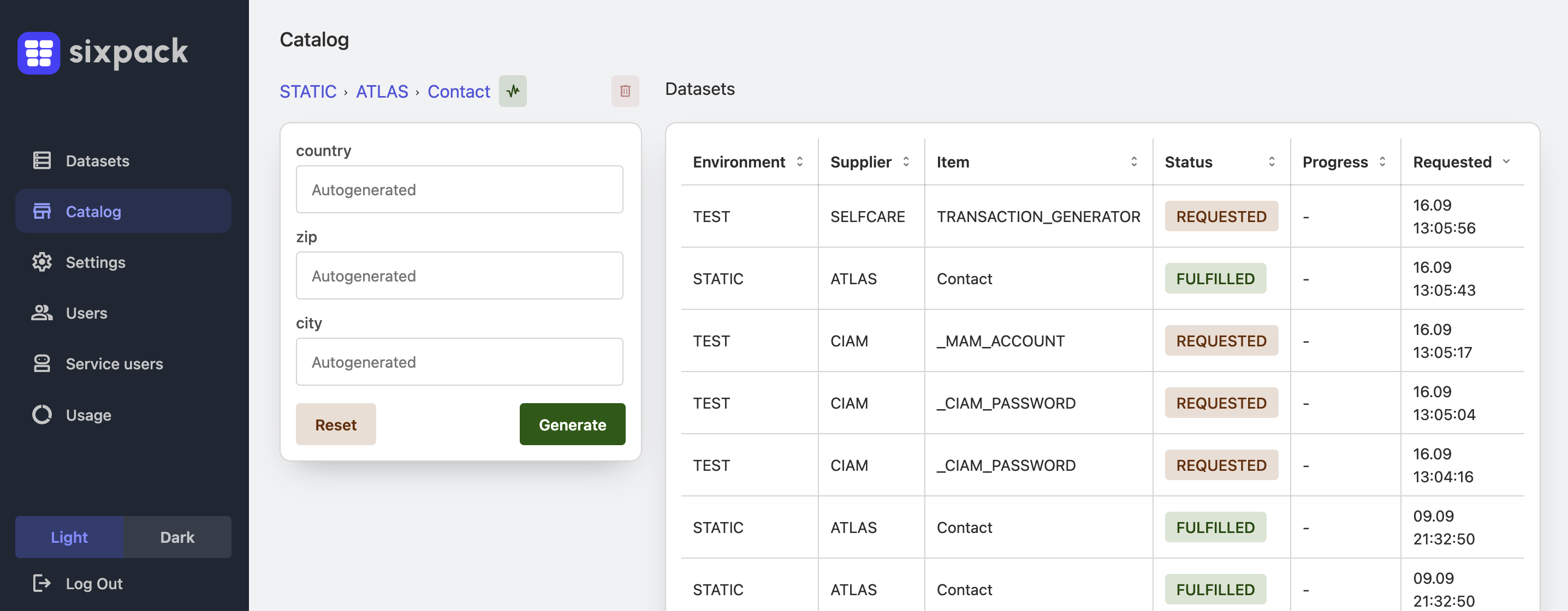
Sixpack catalog interface
Request dataset

Request Data

Pipeline asks for the
required business state

Allocate dataset

Allocate State

Ready data returned
or requested on demand

Run pipeline

Run Pipeline

Execution starts without
manual setup handoffs

Definition

What test data in CI/CD pipelines means

In CI/CD, there are usually two kinds of test data. Pure unit or isolated system tests can often rely on mocked data, because they validate only one component boundary at a time. Integrated-environment validation is different: the pipeline needs business state that is valid across the real landscape.

That means referential integrity across systems, not isolated fake inserts. In Sixpack, the pipeline requests that consistent state on demand through one repeatable delivery model built on buffered datasets, API-based access, dataset leasing, and cross-service orchestration.

Symptoms it fixes

  • Pipeline jobs wait on slow data preparation before the actual tests start
  • Testers invent workarounds with data mocking, polluting the environment with more inconsistencies
  • Repeatable CI is hard when test data setup behaves differently on every run
  • CI/CD is strongly coupled across repos
  • Testers avoid scenarios that modify data because reusing the same data would break it

Where CI/CD Pipelines Lose Time

The tested flow may work, but test data setup still depends on other systems being up

Failure mode

The pipeline is green until test data becomes the bottleneck

Build and deploy may complete quickly, but integrated-environment validation still waits because the required customer, order, or account state must exist consistently across the whole landscape.

Failure mode

Workarounds add even more inconsistency

When teams compensate with mocking or isolated fake inserts, the environment drifts further away from the landscape the pipeline is supposed to validate.

Failure mode

Repeatable CI breaks when data setup changes every run

If test data is rebuilt differently on each execution, reruns stop meaning anything and pipelines become unreliable even when the product itself has not changed.

How Sixpack Fixes It

Only the platform capabilities that matter when delivery flow depends on valid, fast, repeatable data

Sixpack gives pipelines one route to business-valid data even in distributed systems, while the teams that understand each domain keep ownership of how those states are actually created across the integrated environment.

Proven architecture pattern and methodology

Sixpack is built on years of experience solving test data bottlenecks in complex enterprise environments, where parallel tests fail not because execution is slow, but because valid state is hard to prepare, isolate, and reuse safely.

Buffered datasets for immediate pickup

Sixpack keeps commonly requested states pre-generated and stocked, so CI jobs can start from ready business-valid data that stays available even when some systems needed to produce it are temporarily down.

REST access for automated consumers

Pipelines consume datasets through a consistent API model with service users, which means automation can request data without manual portal steps or one-off scripts.

Domain-owned generation logic

Teams that own the systems also own the generators or orchestration steps, so business rules and cross-system consistency stay accurate while pipeline users only request the state they need.

Leasing and lifecycle control

Allocated datasets are reserved per run, then expired or cleaned up by policy, reducing collisions and keeping shared test environments operational.

What The Pipeline Actually Does

A practical request-to-execution flow for automated delivery

Pipeline flow

1. Call Sixpack from the pipeline

The job authenticates with a service user and requests the exact dataset type needed for the stage, environment, and integrated validation scenario.

Pipeline flow

2. Pick up ready or newly fulfilled data

If matching state is stocked, the pipeline receives it immediately. Otherwise Sixpack tracks the request and fulfills it through the relevant generator chain.

Pipeline flow

3. Execute tests on dedicated state

The pipeline runs against a business-valid leased dataset, so the suite validates the real landscape rather than relying on mocks, fake inserts, or slow prerequisite setup.

State On Demand For CI/CD

Four strategies for integrated CI/CD validation

Strategy

Catalogue-driven discovery

Cross-team dependencies are real in integrated environments, but they can be handled through an autoconfigured catalogue and API that expose available dataset types from the generators currently connected for each environment.

Strategy

Cross-service orchestration

Replicating the business process across generators and orchestrators is the cheapest durable way to preserve referential integrity over time, so the pipeline gets one usable outcome instead of rebuilding every dependency itself.

Strategy

Operational resilience

Instability on test and stage environments has to be accepted as a fact and mitigated accordingly. Because prepared datasets are stocked ahead of demand, delivery can continue even when parts of the landscape are temporarily unstable.

Strategy

Test data maintenance

The cheapest way to keep integrated test data valid over time is to maintain generators with the same teams and release cycles that change the underlying systems, so CI/CD does not drift into central bottlenecks.

Integrated pipelines request state, not data setup

Sixpack turns integrated test data creation into a reusable delivery model. Pipelines ask for the business-valid state they need, while generators, orchestration, buffering, and lifecycle control preserve referential integrity across the landscape and mitigate unstable test environments behind the platform boundary.

Pre-generated validation state shortens the critical path

Sixpack prepares integrated business-valid state ahead of demand, so the slowest part of test data provisioning does not have to run inside every pipeline.

Pipelines request state without rebuilding setup logic

The pipeline asks for a dataset type through a simple API call while Sixpack hides cross-service setup complexity behind one repeatable request model.

The same starting state can be requested across runs and repos

Teams stop re-implementing fragile data setup in multiple repositories and rely instead on one reusable way to order valid state for integrated validation.

Allocated datasets prevent shared-environment collisions

Each pipeline run gets its own leased dataset, so reruns and parallel jobs do not corrupt the same state and make the environment even less trustworthy.

What Changes In Distributed Environments

Teams can work independently while integrated validation still gets coherent starting state

Shorter pipeline lead time

Validation stages spend more time testing real integrated behavior and less time building prerequisite data from scratch.

More reliable reruns

A failed job can request the same class of state again instead of depending on whatever manual setup happens to be available next.

Less cross-team waiting

Pipeline users do not need to pause for another team to confirm how to create or validate the required business state.

What Changes When Pipeline Data Is Ready

CI/CD gets faster because data provisioning stops being an improvisation problem

Prepared state

Pre-generated validation state shortens the critical path

Sixpack prepares integrated business-valid state ahead of demand, so the slowest part of test data provisioning does not have to run inside every pipeline.

Simple API

Pipelines request state without rebuilding setup logic

The pipeline asks for a dataset type through a simple API call while Sixpack hides cross-service setup complexity behind one repeatable request model.

Repeatable CI

The same starting state can be requested across runs and repos

Teams stop re-implementing fragile data setup in multiple repositories and rely instead on one reusable way to order valid state for integrated validation.

Landscape safety

Allocated datasets prevent shared-environment collisions

Each pipeline run gets its own leased dataset, so reruns and parallel jobs do not corrupt the same state and make the environment even less trustworthy.

Representative pipeline scenario

A regression run no longer waits on another team to prepare a valid business state

A delivery pipeline needs a customer with the right lifecycle, downstream service alignment, and payment readiness before order-to-cash checks can start. Because the validation runs on an integrated environment, mocking or injecting isolated fake data is not enough. With Sixpack, the pipeline requests that consistent cross-system state directly and starts once the dataset is allocated.

Direct answers for teams evaluating how to make pipeline test data faster, repeatable, and independent of manual setup

FAQ

What is test data provisioning in CI/CD pipelines?

In CI/CD, test data provisioning means making the required business-valid state available to a pipeline when validation starts. Sixpack does that through buffered datasets, API-based requests, leasing, and orchestration across generators, so pipelines request state instead of rebuilding it manually.

Sixpack

Keep test data provisioning off the critical path of delivery

When valid state is available on demand, CI/CD can validate product behavior immediately instead of waiting on manual preparation, fragile setup scripts, or hidden service knowledge.