Failure mode
The scenario is valid in one service and broken in another
A customer exists, the order is prepared, but billing or delivery still rejects the flow because its local state was not advanced with the rest of the landscape.

Sixpack coordinates consistent test data across microservices, so testers and pipelines can request a valid business state without learning the full service landscape or waiting for every team to confirm the dataset.
The customer service says the account is active, but order, billing, and delivery each reject a different part of the same scenario. The test is blocked until someone reconstructs the full dependency chain.
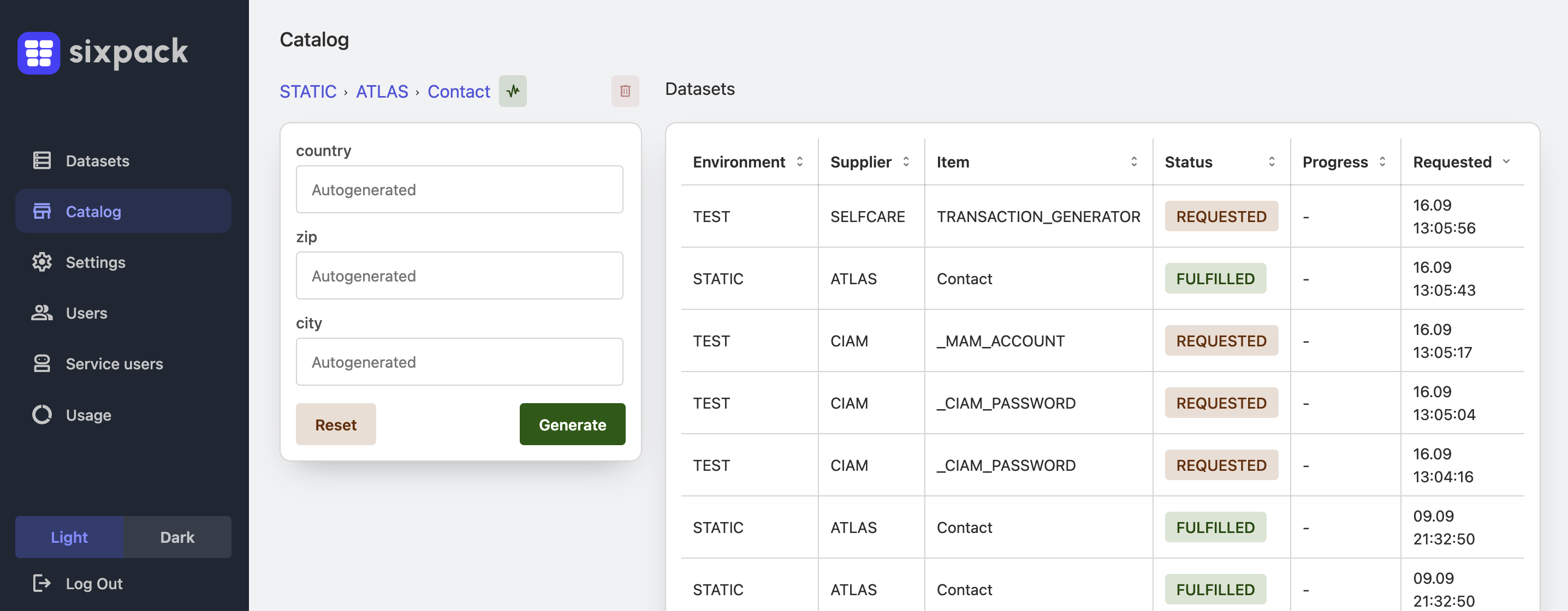

Ask for the scenario
the test needs

Compose valid state
across services

Execute without waiting
on other teams
Definition
In microservices, valid test data is not only a row, customer, account, or order. It is a business state that must remain coherent across independently owned services, schemas, identifiers, events, and lifecycle rules.
Sixpack turns that into a requestable state contract: domain teams publish generator capabilities, Sixpack orchestrates them, and consumers receive data that is ready for valid execution.
Symptoms it fixes
Integrated tests fail when the dataset is only locally valid
A customer exists, the order is prepared, but billing or delivery still rejects the flow because its local state was not advanced with the rest of the landscape.
Each domain team understands its own service, but the test depends on the combined state. QA gets stuck collecting partial confirmations instead of executing the scenario.
When the only way to create data is a fragile script chain, every pipeline quietly depends on hard-coded service order, implicit IDs, and tribal knowledge.
Only the capabilities that matter when valid state spans multiple teams and services
Sixpack keeps service knowledge with the domain teams that own it, but gives testers and pipelines one stable way to request the scenario they need. The platform coordinates generation, orchestration, buffering, and delivery behind that request.
Designed for fragmented ownership
The point is not to centralize all system knowledge in one team. The point is to make distributed knowledge usable through contracts that preserve domain ownership while removing the execution bottleneck.
Sixpack exposes dataset types as business states testers and pipelines can request directly. The consumer asks for the scenario outcome, not for every service-level insert or transition.
Teams keep ownership of the logic that creates valid state in the systems they understand, while Sixpack makes those capabilities discoverable and reusable through one catalogue and API model.
Generator capabilities can be composed across domains so a checkout, onboarding, payment, or fulfilment scenario is prepared consistently before execution starts.
Prepared and leased datasets give teams a repeatable starting point, so reruns investigate product behavior instead of rediscovering which service drifted first.
A practical flow from scenario request to valid cross-service execution
A tester or pipeline asks for a business-valid state, such as a customer ready for checkout, instead of recreating service-specific setup knowledge.
Sixpack uses the relevant generator and orchestration capabilities to prepare coherent data across the services that participate in the scenario.
The suite receives a ready dataset and can validate real cross-service behavior without waiting for another team to confirm that the state is safe to use.
A platform contract for state that crosses service boundaries
Each service team exposes the states it can create or advance. That keeps business rules close to the owning team while giving the organization one stable way to request them.
Sixpack combines domain capabilities into reusable dataset contracts for journeys that cross ownership boundaries, such as customer onboarding, order-to-cash, or policy renewal.
Commonly requested states can be prepared upfront, stocked, and delivered when a tester or pipeline needs them, even when a downstream system is temporarily unstable.
When data preparation fails, the platform can point to the capability or dependency that failed instead of leaving teams to debug a long opaque setup chain.
Sixpack lets each team expose the data states it can create, then composes those capabilities into reusable scenario contracts. Consumers ask for the state they need, while the platform coordinates dependencies behind the scenes.
Testers and pipelines do not need to know every service table, event, or lifecycle transition before they can start a valid test.
The service team updates its generator when its domain model changes, so the shared dataset contract does not decay into central test-data guesswork.
Sixpack coordinates service capabilities and dependency order behind the request, including states that must be created, advanced, or reserved together.
Once a scenario state exists in the catalogue, multiple suites and teams can request it without repeating the same discovery and validation meetings.
Teams can keep independent ownership without making test execution wait on everyone
Teams stop blocking test execution on manual explanations from every service owner involved in the scenario.
Integrated tests start from states created through domain logic, not from isolated inserts that only look valid locally.
Reruns start from a known contract, making it easier to separate product defects from data preparation drift.
Practical outcomes teams see when data is prepared as a scenario, not a pile of local records
Instead of validating a customer in one system and discovering a missing downstream record later, the dataset is prepared as a coherent scenario contract.
Domain knowledge stays with the teams that own each service, while the request model gives testers and pipelines a clear business-level entry point.
When a test fails, teams can request equivalent state again and investigate behavior, not whether a manual setup instruction changed.
Representative microservice scenario
A team needs a customer that can place an order, pay successfully, and trigger delivery rules. Instead of asking customer, order, billing, and delivery teams to validate one shared dataset manually, the test requests that scenario through Sixpack and starts from orchestrated cross-service state.
Microservice data consistency is one part of the broader Sixpack operating model
Sixpack also helps teams provision data inside CI/CD pipelines, isolate state for parallel test execution, replace slow provisioning workflows, and remove cross-team dependencies around test data.
Sixpack
When teams can request valid microservice state through one catalogue and API model, test execution stops depending on fragmented system knowledge.