Fragmented system knowledge
The team that needs data does not own every dependency
A modern test data management tool has to deal with business rules, service order, IDs, lifecycle states, and validation logic that are spread across teams.

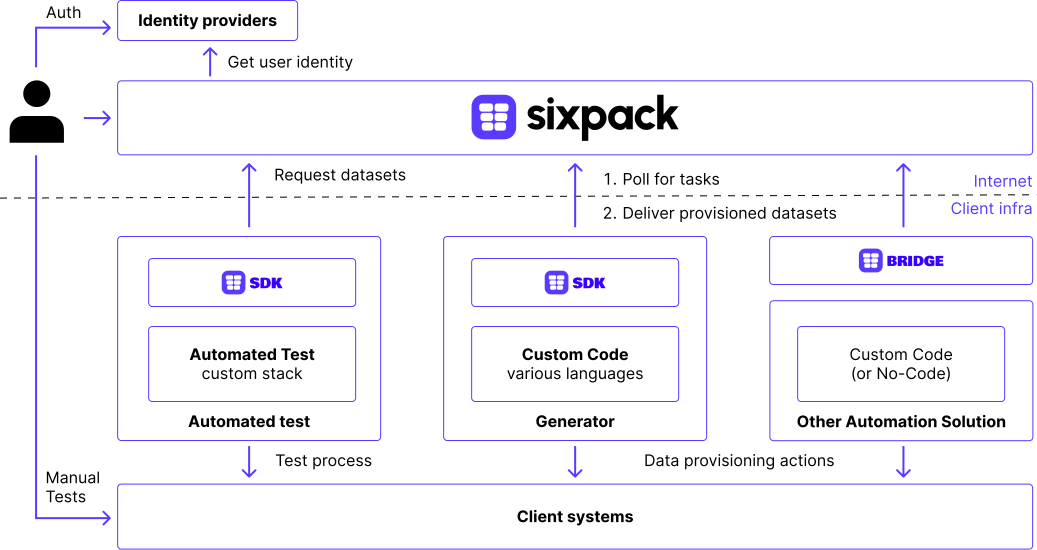
Sixpack provides self-service and API-based test data orchestration for teams that need business-valid datasets across CI/CD pipelines, microservices, parallel test runs, and shared test environments. It turns domain-owned data generation into requestable, allocated, production-like test state for manual testers, automation, and delivery pipelines.
Evaluation lens
Sixpack is most relevant when valid test data is blocked by fragmented system knowledge, shared-environment collisions, production-copy constraints, or setup work that automation has to rebuild in every suite.
Evaluate tools by whether they remove the bottlenecks that stop testing
Fragmented system knowledge
A modern test data management tool has to deal with business rules, service order, IDs, lifecycle states, and validation logic that are spread across teams.
Manual dependency queues
When testers and pipelines must ask other teams to prepare or confirm data, the tool is only documenting the wait instead of removing it.
Environment pressure
A tool that works for one manual tester may fail when multiple pipelines, teams, and microservices consume data at the same time.
Concrete capabilities teams can evaluate when comparing test data management tools
Catalogue
Dataset types are discoverable in one place, so testers and pipelines can request a business state instead of searching through scripts, tickets, and team-specific instructions.
API delivery
CI/CD jobs and automation suites can request, pick up, and refresh datasets programmatically through a stable API contract.
Generators
The teams that understand each system keep ownership of the generation logic while Sixpack handles discovery, orchestration, retries, and delivery.
Orchestration
Generator capabilities can be composed into a reusable scenario state that stays valid across services, lifecycle rules, IDs, and dependencies.
Buffering
Frequently requested states can be generated ahead of demand, stocked, and delivered quickly even when some data-producing systems are temporarily unstable.
Leasing
Each dataset can be reserved for one tester, suite, or pipeline run, then expired, refreshed, released, or cleaned up by policy.
Typical environments and workflows where Sixpack is relevant
Sixpack is a fit when test data is a shared delivery problem: several systems or teams participate in a scenario, data has to be available before execution starts, and consumers need a request model that works from both UI and automation.
Where it may not fit
If one local fixture, seed script, or database reset reliably prepares every scenario, a full orchestration layer may be unnecessary.
Sixpack is not mainly a production-data masking, subsetting, or analytics product; it focuses on delivering requestable test states for execution.
The strongest fit appears when domain teams can publish or maintain generators that encode the rules behind valid data.
CI/CD
Sixpack fits when automated jobs need valid account, customer, order, policy, payment, or other scenario state before integration and regression checks start.
Distributed systems
It is relevant where one test scenario spans multiple services, teams, databases, events, APIs, or lifecycle transitions and no single requester owns the whole setup.
Shared environments
Sixpack fits shared non-production environments where testers, automated suites, and partner flows compete for realistic data and need controlled allocation.
Parallel execution
It helps when parallel runs fail because they reuse mutable data, require fragile sequencing, or spend too much time rebuilding prerequisites.
Self-service
It fits teams that want testers to request usable data directly while domain teams maintain correctness through generators and platform teams own delivery standards.
Privacy-aware testing
Sixpack is relevant when teams want production-like synthetic or generated data rather than broad production copies, masking-only workflows, or unmanaged shared datasets.
Map tool evaluation to the delivery problems your teams already recognize
Use case
Typical bottleneck
Pipelines rebuild setup scripts, wait for ticket-driven preparation, or skip realistic integrated scenarios.
Sixpack approach
Jobs request prepared business-valid state through REST-based dataset delivery and leasing.
Use case
Typical bottleneck
Concurrent runs share mutable data, collide on lifecycle state, or require fragile suite ordering.
Sixpack approach
Dataset leasing gives each run isolated state and makes allocation, expiration, and reuse visible.
Use case
Typical bottleneck
Requesters must learn hidden service dependencies, IDs, events, and lifecycle rules before they can build valid state.
Sixpack approach
Domain-owned generators let requesters consume a coherent cross-service scenario outcome.
Use case
Typical bottleneck
Manual handoffs and one-off scripts stay on the critical path before every test cycle.
Sixpack approach
Self-service provisioning moves valid state behind one reusable platform request.
Use case
Typical bottleneck
Consumers wait for another team to explain, prepare, or validate the data before testing can start.
Sixpack approach
Self-service dataset access lets teams request valid state without repeated cross-team handoffs.
Use case
Typical bottleneck
Teams rely on production clones or masking workflows even when the test only needs production-like business behavior.
Sixpack approach
Synthetic and generated datasets can be requested as scenario state without broad production-data copying.
Operating model
Definitions are useful, but teams comparing test data management tools need to know whether a product changes the operating model. Sixpack connects generator orchestration, stocked datasets, self-service delivery, and API access so test data stops being rebuilt inside every team workflow.
Catalogue
Sixpack exposes dataset types through a catalogue so teams can see what business states are available without searching through team-specific scripts or chat history.
Orchestration
Generator capabilities stay close to the teams that know the systems, while Sixpack composes them into usable cross-system datasets.
Delivery
Testers and pipelines consume datasets through UI or REST API, with buffering, allocation, expiration, and observability handled by the platform.
Governance
Domain teams maintain the rules that create valid state, while platform teams standardize how data is discovered, requested, leased, monitored, and retired.
Test data management tool evaluation
Sixpack is relevant when teams need one operating model for self-service discovery, API delivery, generator orchestration, buffered datasets, leasing, lifecycle control, and observability across non-production test environments.